Georgetown is two towns, and they do not own the same machines
About twenty minutes northeast of us, across 78626, 78628 and 78633. There is a hundred-year-old core around the courthouse square and there is a fifty-five and over community on five thousand acres that did not exist before 1995, and a shop that quotes those two the same way has not been to both of them.
Start with the free tune-up you are probably owed
Georgetown owns its electric utility. It is the only town in this service area where the power company is the city itself, and that utility offers residential electric customers one free HVAC tune-up per year.
It is a real program with real terms. You have to be a current residential electric customer and the homeowner, the system has to be operating, and it covers standard equipment, meaning central air conditioning, a heat pump or a furnace. Window units do not count. The inspection covers the compressor, the coil, the fan and the controls, plus airflow and ductwork, with performance testing and a written report at the end. The city says requests are reviewed within five business days and scheduled within thirty.
We are telling you this knowing it is a visit we do not get paid for. We have not confirmed whether it is an eligible provider under that program, so do not book us expecting it. Go to the city's page, take the free one, and read the report. If the report says something is wrong, then call us and we will look at it properly.
One caution about the utility itself. Georgetown's electric service area does not line up neatly with the city limits, so not every Georgetown address is on the municipal utility. Check the city's own map before you assume the program applies to you.
Source: Georgetown Electric residential HVAC tune-up program.
The fifty-fifty town
Census fuel data puts Georgetown at roughly 48.7 percent utility gas and 49.3 percent electricity for home heating. That is as close to an even split as anywhere we work, and it is the reason this page cannot pick a side. Drive four blocks and the heating system changes species.
A gas furnace fails loudly and it fails on ignition. A heat pump fails quietly, by giving up and handing the whole job to the auxiliary strip heaters, and the first symptom is not a cold house at all. It is an electric bill in February that makes somebody call the city about a meter problem. Those are two completely different service calls and we handle both. Heating and heat pump repair goes through what each one looks like.
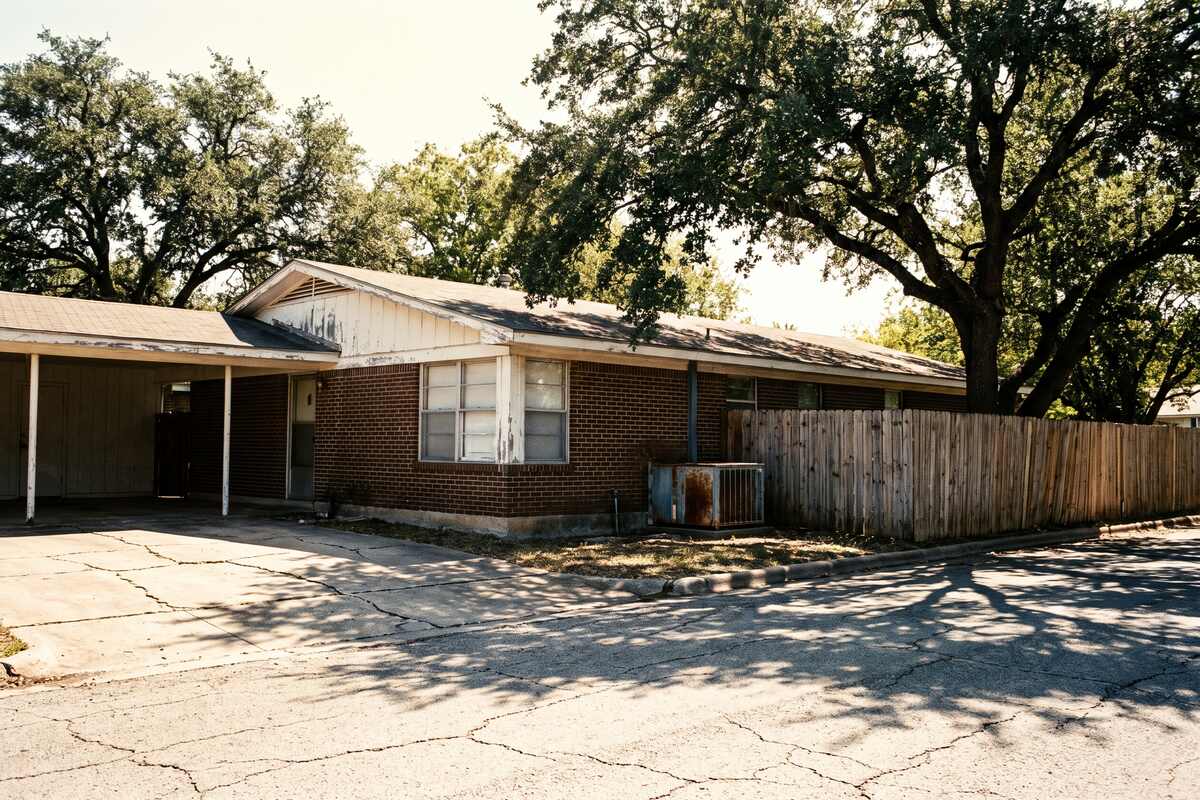
The stock underneath that split is genuinely mixed. The median Georgetown home dates to 2008 and about sixty-nine percent of the housing went up after 2000, but there is also a real historic core: roughly 578 units built before 1940, clustered around the 1911 Williamson County Courthouse, in a district that has been on the National Register since 1977. That is the square Georgetown itself bills as the most beautiful in Texas, and those houses have had heating and cooling grafted onto them in stages over eighty years.
Sun City, Wolf Ranch, and the courthouse blocks
Sun City Texas is a Del Webb active adult community. It launched in 1994 when Del Webb bought more than 7,000 acres out here, home construction began in October 1995, and the first residents were moving in by spring 1996. Thirty-one years of phases means thirty-one vintages of equipment sitting side by side. The earliest sections are on their second changeout and some are on their third. The newest ones are still inside a manufacturer warranty. Same community, same street grid, completely different conversation depending on which phase your house came out of.
It is also the easiest place in this service area to schedule work, because somebody is usually home in the middle of a Tuesday. That matters more than it sounds when the alternative is a week of missed connections.
Wolf Ranch is two different things and locals know it even if search engines do not. The shopping center out by the interstate opened in July 2005. The residential community of the same name, out along Highway 29 by the San Gabriel River, did not break ground until December 2015, on about 755 acres, planned for something over 1,600 single-family homes. Two unrelated projects a decade apart sharing a name. If somebody tells you they know Wolf Ranch, ask which one they mean.
Equipment in the residential side is young enough that most of what we see there is a commissioning problem rather than a wear problem: a system that never quite got balanced, or a return that cannot feed what the builder installed.
Downtown is the opposite job entirely. A pre-1940 house with an attic that was not designed for ductwork, a floor plan that has been changed, and an air handler wedged somewhere nobody would choose. Those get measured rather than assumed.
Your water depends on which plant feeds your street
This is the strangest true thing about Georgetown and almost nobody writes it down. The city runs multiple treatment plants and the hardness is not the same between them. The Lake Georgetown and Southlake plants come in around 176 to 178 milligrams per litre, call it ten or eleven grains. The Park and Southside plants run 309 to 320, which is around nineteen grains. The city's own words are that its water ranges from hard to very hard depending on the source serving your location.
Nineteen grains is nearly double ten. Two houses in the same city, same age, same equipment, and one of them will foul a condensate trap and scale a drain pan roughly twice as fast as the other. If your neighbor two miles away has never had a drain backup and you have had three, you are not unlucky. You are on a different plant.
It is also why we do not write one maintenance interval for the whole town. See indoor air quality and filtration for the part of this that is about what you breathe rather than what drains.
Permits: Georgetown names the inspection after the job
The city requires a permit to erect, install, enlarge, alter, repair, remove, convert or replace any electrical, gas, mechanical or plumbing system. Replace is in the list, in writing. Better than that, the city's inspection types include one called Mechanical Change Out, which is about as unambiguous as municipal language gets.
Trade permits require a registered contractor and registration with the city costs nothing. A homeowner doing their own work has to file a Homeowners Exempt Form first. Everything goes through the My Government Online portal, and an inspection requested by three in the afternoon gets the next business day.
Georgetown has run the 2021 international codes, mechanical code included, alongside the 2023 National Electrical Code since the first of November 2023. Worth noticing how little agreement there is across one county: Round Rock is a full cycle ahead on the 2024 codes, Liberty Hill is on the 2021 codes with the 2020 electrical. Three towns, three vintages, and the one that applies is the one your address sits in.
We pull it, we schedule the inspection, and you get the paperwork, which matters more than people think on the day they sell the house.
Source: City of Georgetown HVAC permits.
Proposed content. Tony, this is your section to fill.
We could not source the one number that would make this page unbeatable, because nobody publishes it: what actually gets installed in Sun City. Are those mostly heat pumps or gas? What size dominates? Are you seeing more failures out of the 1990s phases than the 2000s ones? And is Two Seasons able to enroll as a provider for the city's free tune-up program, because if so that is a standing stream of first visits and it belongs at the top of this page instead of buried here.
Georgetown questions, answered straight
Does the city really give me a free HVAC tune-up?
If you are a residential electric customer of the city utility and you own the home, yes, one per year on a working standard system. Take it. It is your money already. Read the report it produces and treat anything it flags as worth a second opinion rather than as a sales pitch.
Is my house on gas or electric heat, and why does it matter to you?
Because this town is split almost down the middle and the diagnosis starts in a different place for each. If your outdoor unit runs in January you have a heat pump. If a burner lights and there is a flue, you have a furnace. Tell us which on the phone and we bring the right parts the first time.
My drain line keeps clogging and my neighbor's never does.
Check which treatment plant serves each of you. The hardness across Georgetown runs from about ten grains to about nineteen depending on the source, and the harder end scales a trap dramatically faster. It is a real difference, not a maintenance failure on your part.
Do you work in the old houses downtown?
Yes, and we quote them differently. A pre-1940 house near the square has constraints a 2015 build does not: no usable attic run, a chimney where you want a flue, and a floor plan that has been changed twice. That takes longer to look at and we say so up front instead of finding out on installation day.
Nearby
Round Rock is straight down the interstate and runs on Oncor rather than a city utility. Liberty Hill is eighteen miles west by the neighboring city's own distance table. Leander is where we start every morning.
Take the free one first. Then call us if it turns up something.
When you do, it is $75 for a real diagnosis on the whole system, not a guess at the part making the most noise. You get told what is wrong and what it costs before any of it comes apart.
Monday to Friday, 7:00am to 5:00pm. Saturday and Sunday by appointment.