Round Rock has about seventeen thousand houses in the replacement window at once
Twenty minutes east of us, mostly across 78664 and 78681. It is the biggest city we cover and it carries a number that shapes everything on this page: roughly a third of its housing went up between 1980 and 1999, which works out to something near 17,500 homes now between twenty-seven and forty-six years old.
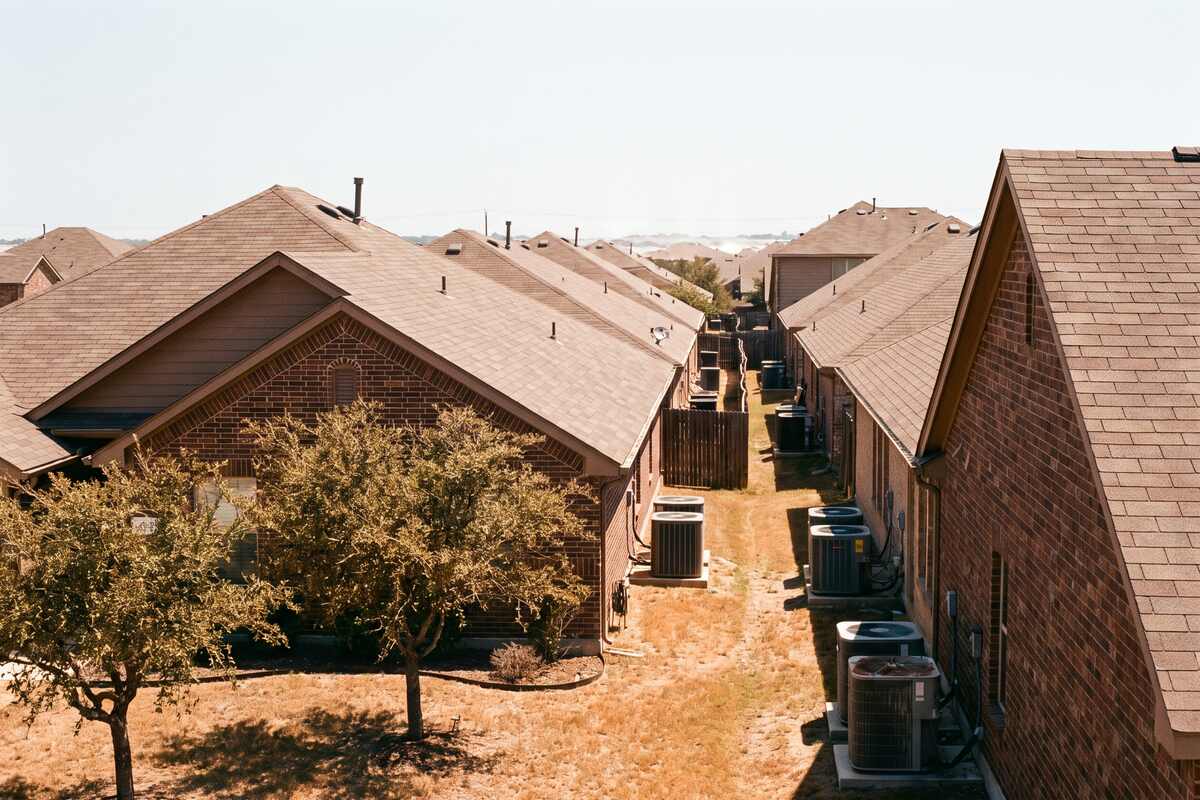
The oldest big housing stock we work in
The median Round Rock home dates to 2002, which sounds unremarkable until you look at the spread underneath it. Nearly a quarter of the city predates 1990. About fourteen percent of everything here went up in the 1980s and close to eight percent in the 1970s. Nowhere else in this service area carries that much genuinely older housing at that scale.
Age changes what the job is. A 1980s single story in this town has usually had two systems in it already and still has its first ductwork, sitting in an attic that was never intended to hold conditioned air. Somewhere along the way somebody added a room, and nobody added a return to serve it. The equipment gets blamed for that every single time.
Heating splits close to even, tilting slightly gas at about fifty percent against forty-seven percent electric, so we walk into furnaces and heat pumps in roughly equal measure and cannot assume either from the address. Forest Creek and the neighborhoods around it are the shape of the thing: established, wooded now, and full of equipment that has outlived at least one owner.
None of that is a reason to panic. It is a reason to know what you have before July decides for you. Looking at it in March costs a fraction of what an August failure costs, and on a thirty-year-old house it also tells you how much runway is left.
Oncor country, which means the rebate question has a different answer here
Round Rock sits in Oncor delivery territory. Unlike the cooperative towns west of here, that puts you in the deregulated retail market, where the wires company and the company that bills you are two different businesses.
Efficiency money in Oncor territory runs through the Take A Load Off, Texas residential program. The important structural detail, and it trips people up constantly: those incentives are claimed by an enrolled participating service provider, not by you. You cannot file for it yourself after the fact. It has to be set up through a contractor who is already in the program, before the work happens.
We have not confirmed whether we are enrolled, so we are not going to imply that we are. Ask on the phone. If the answer is no, that is worth knowing before you compare quotes, because an enrolled shop's number and a non-enrolled shop's number are not measuring the same thing. We would rather you find that out from us than from a spreadsheet three weeks later.
Permits, and the two districts outside the city that Round Rock still inspects
A changeout in Round Rock needs a mechanical permit and a final inspection, pulled as a residential standalone permit. Contractors have to register with the city, and registration is free. The city is on the 2024 international codes and the 2023 National Electrical Code, which is the newest package anywhere in this service area and a full code cycle ahead of some of its neighbors.
Here is the part that surprises homeowners. Round Rock's permit jurisdiction reaches past the city limits into the Chandler Creek and Vista Oaks municipal utility districts. If your address is in one of those, you are outside the city and still inside its inspection authority, which is exactly the situation people assume means nobody is checking.
Then there is Brushy Creek, off 620 just west of here. It is not a city. It is an unincorporated community with its own utility district, and it has been one for a long while: residential development started there in the mid 1970s, the district was in place by the late 1970s, and the bulk of it filled in during the early 1980s building boom. It is the most gas-heated place in this whole service area at about sixty-two percent, with a median build year of 1995.
Because it is unincorporated and Williamson County runs no residential building permit program for single-family homes, a full system replacement out there normally gets no permit and no inspection at all. The county says it plainly: Texas counties were never given general zoning authority, so it does not issue building permits except on health and safety matters.
We do the work the same either way and we will pull the permit where one exists. Where none exists, the state license is the only check in the process, and ours is TACLB00070086C. Look it up before you let anybody into your attic, ours included.
The hardest water on this side of the county
Round Rock's own consumer confidence report gives total hardness as 249 milligrams per litre, which the city itself converts to about 14.55 grains per gallon. The sample table in the same report runs from 184 up to 358 depending on the source and the day.
That is meaningfully harder than Cedar Park, which publishes 10.7 grains for its own supply. Which is odd, because the two cities are partners in the same regional water authority and share a plant drawing off Lake Travis. Round Rock's primary supply is Lake Georgetown, topped up from Stillhouse Hollow, the Edwards Aquifer and that Lake Travis share, and the blend is what pushes the number.
Worth noting that Round Rock is one of the few cities around here that publishes a hardness figure at all. Leander and Liberty Hill do not, and Texas does not make them. That is not a criticism of those cities, it is a reason to be suspicious of anybody who quotes you a number for a town whose utility has never printed one.
The ground is different out here too, and this one is documented rather than folklore. The USDA soil survey puts the Blackland Prairie east of the Balcones Escarpment, formed on Cretaceous shales, and specifically names the clays it produces as having high shrink and swell behaviour. Round Rock straddles the transition, with the western side of the city sitting on Edwards limestone instead, which is why it can pull from Edwards wells at all. Ground that moves seasonally is ground that eventually shifts a condenser pad and stresses a line set, and on the east side of town that is worth a look during any service call.
On the water side it shows up in one place first: the condensate pan and the trap. Mineral builds on the pan surface, the trap narrows, the line finally stops draining on the hottest week of the year, and the safety switch shuts you down. That is not a component failure. It is a water chemistry problem wearing a component failure costume, and on thirty-year-old equipment in this town it is one of the most common calls we take.
Proposed content. Tony, this is your section to fill.
Two things only you can answer, and both would carry this page. First: in the 1980s and 1990s Round Rock stock, how often does the duct actually have to be reworked for a new system to perform, honestly, as a fraction of jobs? No dataset publishes that and every competitor is guessing. Second: is Two Seasons an enrolled participating service provider with Oncor? If yes, it belongs in the second paragraph of this page rather than a maybe. If no, that is worth a conversation, because it is money your Round Rock customers cannot get through you.
What Round Rock homeowners ask us
Do I need a permit for a changeout in Round Rock?
Yes. A mechanical permit and a final inspection, filed as a residential standalone permit, by a contractor registered with the city. Registration is free, so there is no reason for a legitimate shop not to have done it.
I live in Brushy Creek. Same rules?
No, and this catches people. Brushy Creek is unincorporated, and the county does not run a residential building permit program, so typically no permit and no inspection apply to your changeout. That is precisely why the contractor's state license matters more out there, not less.
Why does my drain line back up every summer when my parents' house never does?
Round Rock water runs around 14.55 grains per gallon by the city's own figure, harder than the towns west of here. Hard water scales a drain pan and narrows a trap faster. Cleaning the line once a year on older equipment in this city is not upselling, it is arithmetic.
Is Round Rock too far for same-day?
Not usually, but it is a twenty-minute drive each way and on a full day that is the difference between fitting you in and not. You will get told which on the phone. We work Monday to Friday, 7:00am to 5:00pm, and Saturday and Sunday by appointment.
Nearby
Cedar Park is west across the county line with the same age problem and a cooperative instead of Oncor. Georgetown is north up the interstate. Hutto is the newer town further east.
If your house went up before 2000, it has an opinion about August.
$75 gets a licensed tech to Round Rock and a straight answer about the whole system, ducts included, not just the part that is making noise.
Monday to Friday, 7:00am to 5:00pm. Saturday and Sunday by appointment.