The cheapest part of your system, and the one most often wired wrong
A thermostat is a switch with opinions. It costs a rounding error next to the equipment it commands, and when it is set up wrong it will make a perfectly healthy system behave like a broken one, run up a bill you cannot explain, and send somebody out to look at a compressor that was never the problem.
$75 for the service call. Monday to Friday, 7:00am to 5:00pm. Saturday and Sunday by appointment.
The C wire, and why your new thermostat is complaining
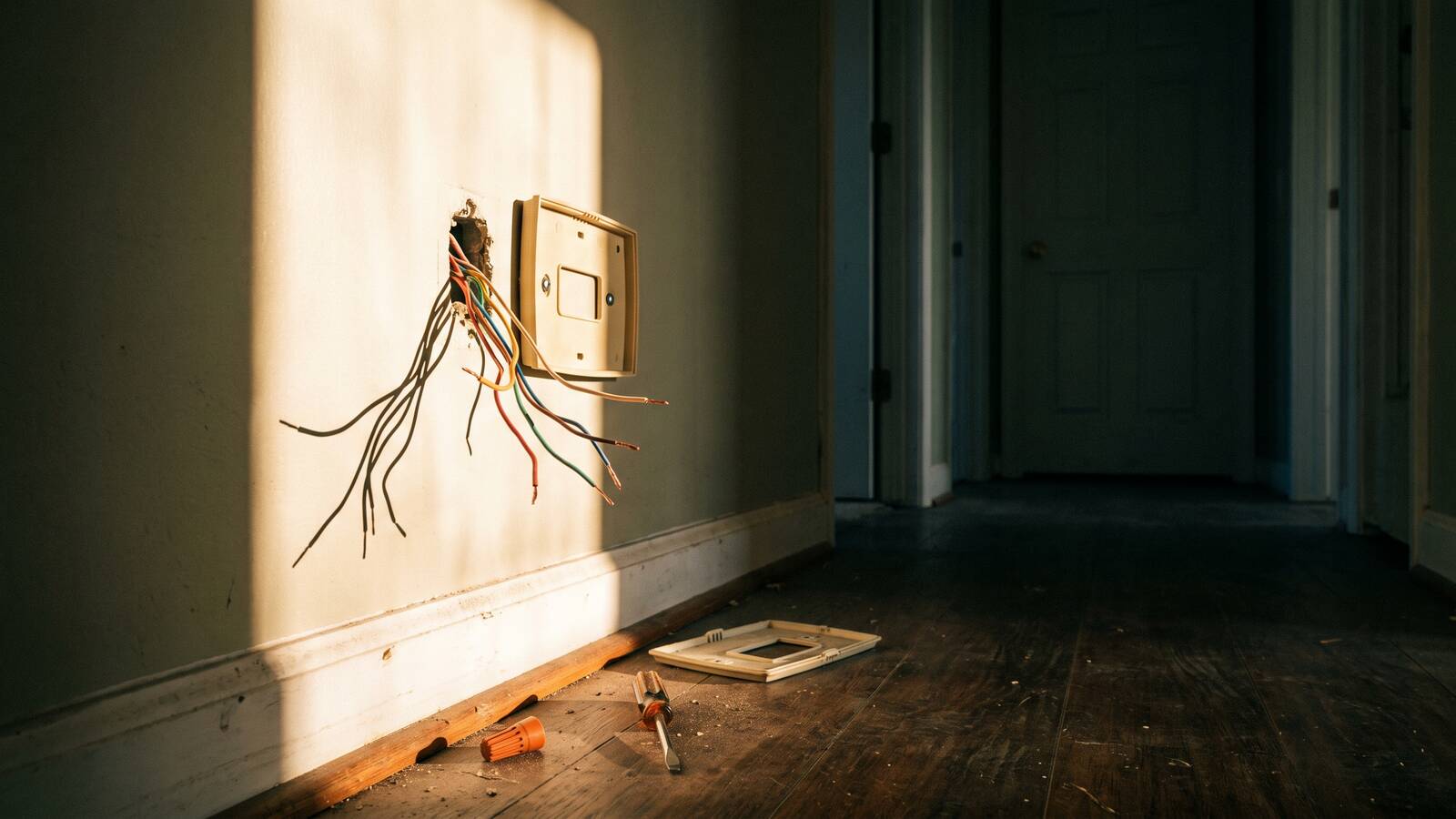
Your thermostat runs on 24 volts from a transformer at the air handler. An old mercury or mechanical stat needed no power of its own, so builders ran four conductors and called it done: R for power, W for heat, Y for cooling, G for the fan. Nothing came back to complete the circuit, because nothing needed to.
A smart thermostat has a screen, a radio and a processor, and it needs continuous power. That is the C wire, the common, and in a house built before smart stats existed it very often is not there. Thermostats that advertise working without one do it by power stealing, trickling a small current through the heating or cooling circuit while the system is off. It works until it does not, and the symptoms are strange enough that people rarely connect them to the thermostat: the display reboots itself, the blower kicks on for no reason, the little fuse on the control board keeps blowing, or the system will not respond at all on a hot afternoon.
There are three real fixes. Often the cable in the wall has five or more conductors and one is simply unused and coiled behind the plate, in which case it is twenty minutes of work at both ends. Failing that, an add a wire adapter at the air handler multiplexes the existing conductors so the stat gets a proper common. And when the run is short and accessible, a new length of thermostat cable is the cleanest answer and the one that never has to be revisited.
Heat pump or conventional, and why the setting is not cosmetic
This is the single most common configuration mistake we find, and it usually arrives with a thermostat somebody installed themselves on a Saturday.
A conventional system has a heater and a separate air conditioner. Call for heat, the furnace runs. Call for cool, the compressor runs. A heat pump has one machine that does both by reversing the direction the refrigerant flows, and a valve decides which. That valve is commanded by a wire the industry labels O or B, and different equipment energizes it in different modes: most call for O to be energized in cooling, some do the opposite.
So a thermostat set to the wrong equipment type, or with O and B set backwards, produces a house that gets cold when you asked for heat, or a heat pump that never runs its outdoor unit in winter and quietly heats you with resistance strips at several times the cost. The wire count grows accordingly on a heat pump: R and C for power, Y for the compressor, G for the fan, O or B for the reversing valve, W2 or AUX for the backup heat, sometimes E for emergency heat and Y2 for a second compressor stage. Miss one and something specific stops working, usually in the season you are not thinking about.
A conventional thermostat on a heat pump is worse than merely wrong. It has no concept of auxiliary heat, no compressor lockout, and no balance point logic, which means the equipment loses every piece of intelligence it was designed around. More on how heat pumps behave in a Central Texas winter.
Why the smart stat you bought is short cycling a two stage system
Two stage and variable capacity equipment is designed to spend most of its life running gently. Low stage is quieter, it holds temperature more evenly, and because it runs longer it pulls far more moisture out of the air, which in this climate is most of what comfort actually means.
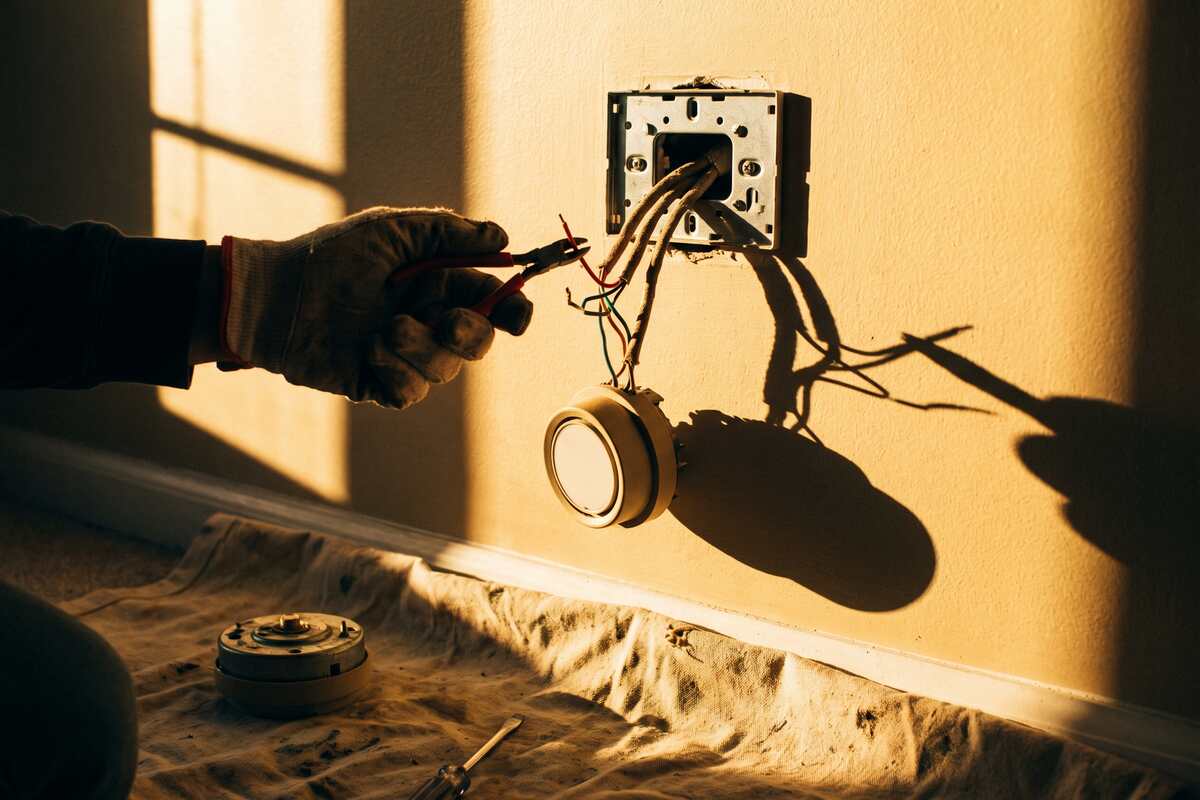
A single stage thermostat wired to that equipment has one on switch. Depending on how it is landed at the board, it either pins the system in low stage permanently, so it can never catch up on a 105 degree afternoon, or it jumps straight to high stage on every call, which is the version people notice. High stage satisfies a small temperature swing quickly, shuts off, and repeats: short bursts of maximum output all day. The house never gets long steady runtime, humidity climbs, and the compressor collects starts, which is the hardest thing it ever does.
There is a second, subtler version of the same problem living in the thermostat's own settings. Cycle rate, sometimes labeled cycles per hour or swing, decides how far the room drifts before the stat calls. Set aggressively tight it will short cycle even correctly matched equipment. Communicating systems avoid all of this by talking to their own matched thermostat over a data link rather than through individual switched wires, which is exactly why an off the shelf replacement on one of those systems is not a swap at all.
Aux heat and emergency heat are not the same setting
Two words on the same screen, two completely different things, and the difference shows up on your January bill.
Auxiliary heat is automatic. On a heat pump it is a bank of electric resistance strips in the air handler, or the gas furnace on a dual fuel system, and the thermostat brings it in alongside the compressor when the house is falling behind or during a defrost cycle. Working correctly, it is a supplement that runs for a while and shuts back off.
Emergency heat is a manual mode that locks the compressor out entirely and runs the strips alone. It exists for the day the heat pump itself has failed and you still need the house above sixty. Resistance heat converts electricity to warmth at exactly one to one, while the heat pump it just locked out moves several times that much heat for the same power. Leaving a house in emergency heat for a week in January is a bill people remember for years.
The practical rule that follows: on a heat pump, do not use a deep setback. Dropping the house eight degrees overnight and asking for it back at six in the morning is a direct instruction to run the strips, because the compressor alone cannot recover that fast. Either leave it close to where you want it, or use a thermostat with adaptive recovery, which starts inching toward setpoint early enough that the compressor can do the work by itself. And if the aux indicator is lit on a mild day, something upstream is wrong and it is worth a phone call before the bill arrives.
Where it lives on the wall
A thermostat measures one spot and rules the whole house, so the spot matters. On an interior wall, roughly five feet up, away from direct sun through a west window, away from lamps, televisions and kitchen heat, and not on a wall with a supply duct running through it, which will heat or cool the back of the stat and make it lie. The worst placement we still find regularly is directly beside or above a return grille, where it reads the mixed air coming back from the whole house instead of the room you are sitting in.
A hallway is the usual compromise and it is usually fine. If one room is always wrong, a remote sensor placed where you actually sleep will do more for you than any other feature on a smart thermostat.
What a replacement actually involves
- Identify the equipment first. Data plate on the air handler and on the outdoor unit. Heat pump or conventional, single stage or two stage, gas or electric backup, and whether the system is communicating.
- Photograph and label both ends. The old stat and the control board. Wire colors lie constantly, especially in a house that has had a thermostat changed before.
- Sort out the common. Spare conductor, adapter, or new cable, decided at the wall rather than hoped for.
- Configure the equipment type. Heat pump versus conventional, O or B orientation, number of stages, auxiliary and emergency heat behavior, compressor lockout, minimum off time and cycle rate.
- Run every mode and verify at the equipment. Cooling, first stage heat, second stage, fan, and emergency heat, confirmed by what is actually energized at the board and by supply air temperature, not by what the display claims.
- Set it up with you standing there. Schedule, app, remote sensor if there is one, and a plain explanation of the aux indicator so it never becomes a mystery.
$75 to come out. It applies to the work if you tell us to go ahead on the same visit. A thermostat is often the cheapest thing on the invoice, and it is worth saying that it cannot fix a system that is low on charge, starved for return air, or fighting bad ductwork. It commands the system. It cannot repair it. How we price the work.
Thermostat questions we get constantly
My new thermostat says it needs a C wire. Now what?
Take the old stat off the wall and count the conductors in the cable, including any that are pushed to the side unused. If there is a spare, you are twenty minutes from done at both ends. If there is not, an adapter at the air handler or a new run of thermostat cable are the two honest answers. Running it on stolen power because the box said you could is how you end up with a blower that starts by itself at two in the morning.
Can I install a thermostat myself?
Many people can, and we are not going to pretend otherwise. It is low voltage and the wiring is not hard. Where it goes wrong is not the wiring, it is the configuration: equipment type, reversing valve orientation, stage count and aux behavior. If your system is a straightforward single stage gas furnace and air conditioner with a C wire present, have at it. If it is a heat pump, a two stage system, or anything communicating, that is where the calls come from.
My electric bill jumped after I installed a smart thermostat.
On a heat pump, that is usually auxiliary heat. Either the stat is configured as a conventional system so it is calling the strips instead of the compressor, or the schedule has a deep overnight setback that guarantees a strip assisted recovery every morning. Both are settings problems, not equipment problems, and both are quick to correct once somebody looks at what is actually energized at the board.
Does a smart thermostat work with a two stage system?
Some do properly, some support two stages only in certain configurations, and some handle it in name only. The thing to check before buying is whether it supports Y2 and W2 for your specific equipment type, and whether it lets you set stage timing rather than deciding for you. On a communicating system, the equipment usually needs its own matched thermostat and a generic one is not an option at all.
What is the difference between aux heat and emergency heat?
Aux is automatic and temporary: the thermostat adds the backup heat alongside a running heat pump when the house is falling behind or during defrost. Emergency heat is manual and total: it locks the compressor out and runs the backup alone, which is the most expensive way to heat a house. Use emergency heat when the heat pump is broken, not when it is merely cold outside.
Will a new thermostat lower my bill?
A little, if the old one was badly configured or you were not using a schedule at all. The savings numbers on the box are advertising, and the parts of your bill that actually move are equipment efficiency, duct leakage, insulation and how the system was sized. A thermostat that is finally set up correctly for your equipment type is worth real money. A thermostat by itself is not a retrofit.
Related
Where we do this work
Your house is not going to fix itself, and it is not getting any cooler out there.
$75 to come out. A licensed tech, a real look at the whole system, and a straight answer about what is actually wrong with it.
Monday to Friday, 7:00am to 5:00pm. Saturday and Sunday by appointment.