Almost nothing in Liberty Hill is old enough to replace yet
Eight miles from us by the city's own distance table, all of it inside 78642. This is the one town on this site where we are not here to sell you a system, because most of the equipment out here is younger than the truck, and what it actually needs is somebody to look at how it was set up in the first place.
A town that tripled, and what that did to the housing
Liberty Hill counted 3,568 people in the 2020 census. The Bureau's 2024 estimate puts it near 11,984. That is more than triple in four years, and it is the fastest growth of anywhere we work by a distance that is not close.
The median home here was built in 2017. Something over eighty percent of the housing has gone up since 2010. And then there is the other end: a small but real slice, somewhere around one home in twenty, that predates 1940 and sits in the original townsite. Between those two there is almost nothing. Liberty Hill skipped the middle of the twentieth century entirely.
Worth being honest about the numbers themselves. The Census survey figures behind this are a five-year average taken over exactly the period the town tripled, so they run behind reality and the housing estimates carry a real margin of error. The direction is not in question. The decimal places are.
This is a warranty-age town, so the work is different
Roughly three houses in four here heat with electricity rather than a gas main. That makes Liberty Hill a heat pump town in practice, and heat pumps go wrong differently than furnaces do. When the outdoor unit stops pulling its weight the auxiliary strip heaters quietly take over and the house stays warm, so nothing feels broken. The bill is the symptom. By the time somebody calls, the system has been running on resistance heat for six weeks.
The rest of what we see out here is not failure at all. It is commissioning. Builder-grade systems in a fast-built subdivision get installed on a schedule, and the things that get shortchanged are always the same: a return that cannot feed the air handler, flex duct pulled tight around a corner, a supply run to the back bedroom that was never balanced, one thermostat asked to govern a two-story house. All of that is fixable and none of it is a new system.
So on a Liberty Hill call we are usually talking about airflow, filtration and zoning rather than a changeout. If your equipment is under ten years old, part of our job is telling you what is still covered under manufacturer warranty before you spend anything. Filtration and air quality and how the thermostat is actually wired to a heat pump are the two we come back to most in this town.
Neighborhoods, acreage, and the line nobody can see
Santa Rita Ranch is the big one, roughly 3,100 acres with well over a dozen builders in it and a welcome center out on Exploration Circle. Orchard Ridge was founded in 2016. Stonewall Ranch, MorningStar, Clearwater Ranch, Grand Oaks of Liberty Hill and Rancho Sienna are the other names the city itself puts in writing on its utility pages. Those are the tight subdivision jobs: newer, closer together, easy to get a truck to.
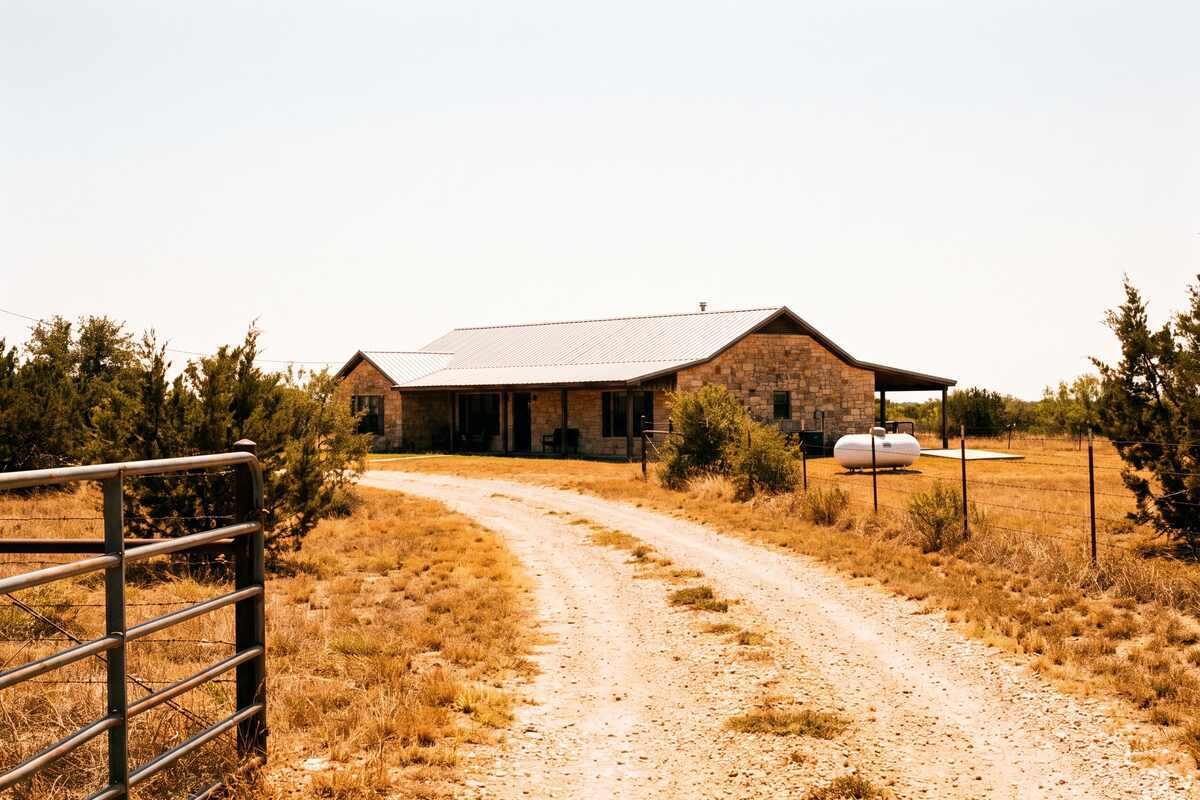
Then there is everything else. A Liberty Hill mailing address covers a lot of ground that is not in the city at all, and out there the lots run to acres and the nearest neighbor is not going to lend you a ladder. Propane shows up on those properties because there is no main to connect to.
Gas here is real but it is a minority fuel, and where it runs is a subdivision question rather than a town question. Atmos Energy is the provider the city names on its own new customers page. The cleanest illustration is Santa Rita Ranch, which announced in 2015 that it was bringing natural gas service to all 500 of its lots, converting the community off propane. So one household in five here is on a main and four in five are not, and which one you are depends on when your neighborhood was platted and what the developer negotiated.
Liberty Hill sits around 1,025 feet, the highest of the towns on this side and roughly 118 feet above Cedar Park. From downtown Austin you climb better than five hundred feet to get here. That is the Hill Country stepping up, and it is why the drives out to the west side of this town take longer than the mileage suggests.
For orientation, the town sits between the north and south forks of the San Gabriel River, on State Highway 29 about fifteen miles west of Georgetown. The International Sculpture Park goes back to a 1976 symposium that brought sculptors from six countries here for two months, and the work is now out at Louine Noble Elementary on Loop 332. Lions Foundation Park is the other one everybody navigates by.
Permits here are spelled out, and so is the city limit
Liberty Hill's permit page states it in the clearest words of any city we work in: installing or replacing heating and air conditioning equipment is listed under alterations requiring a building permit. Permits expire after 180 days. Inspection requests submitted by three in the afternoon get next-business-day service, through the MyPermitNow portal. The city runs the 2021 international codes, mechanical code included, with the 2020 National Electrical Code.
The genuinely useful thing on that same page is a tool that answers whether your property is inside the city limits. Use it. It matters here more than in any other town on this site, because so much of the Liberty Hill mailing area is unincorporated Williamson County, and the county runs no residential building permit program. Inside the line there is a permit and an inspection. Outside it there is neither, and the only thing standing behind the work is the contractor's state license.
Source: City of Liberty Hill building permits and inspections.
Three different cities might be selling you your water
This is the fact about Liberty Hill that nothing else in the region matches, and the city publishes it plainly. Who supplies your water depends on which subdivision you live in. Inside the city limits it is the City of Liberty Hill. Rancho Sienna buys from the City of Leander. Stonewall Ranch, Orchard Ridge, MorningStar, Clearwater Ranch, Santa Rita and several others buy from the City of Georgetown.
The city's own quality report spells out where its share comes from: it purchases treated water from Leander, which is surface water off Lake Travis, and it runs four of its own groundwater wells in the Trinity Hensel aquifer. The groundwater half leaves a signature in the numbers, with combined radium at 3.43 picocuries per litre and gross alpha at 7.2, both comfortably under the limits and both exactly what a Trinity well looks like.
What that report does not contain is a total hardness figure, and Texas does not require one. Neither does Leander's. So we are not going to print a Liberty Hill number the way we can for Round Rock. What is defensible is this: if your street buys from Georgetown, that city does publish figures, and they run anywhere from about ten grains to about nineteen depending on which of its plants feeds the line. The Trinity well share is very likely harder still. Anyone quoting you one precise Liberty Hill hardness number got it from a water softener company, not from a utility.
Proposed content. Tony, this is your section to fill.
The gap on this page is equipment, and nobody publishes it. In the newer Liberty Hill subdivisions, what fraction of the systems you look at are straight heat pumps versus dual fuel? How often is the fix a return-air change rather than anything on the equipment? And out on the acreage, how many propane furnaces are you actually seeing, because the survey data says a few percent and survey data does not drive out there. Your call sheet knows and the Census does not.
What people ask us out here
My house is six years old. Why does the upstairs never keep up?
Almost always duct and return, not capacity. A new house in a fast-built subdivision gets a system sized on paper and installed on a schedule, and the first casualty is airflow. We measure it before recommending anything, because adding tonnage to a duct system that cannot move what it already has just makes a louder problem.
Is my property actually in Liberty Hill?
Maybe not, and it changes whether your job gets permitted and inspected. The city publishes a tool on its permits page that answers it in about ten seconds. Check it before you take a quote from anybody, ours included.
I am on propane out on acreage. Do you work on that?
Yes. Out past the mains propane is normal, and a propane furnace is a different animal from a natural gas one at the burner and the orifice. Tell us on the phone which fuel you have so the right parts are on the truck for a drive we are not making twice.
What is emergency heat and should I be using it?
It is the setting that shuts the heat pump off and runs the strip heaters alone. It is for when the outdoor unit is genuinely broken, not for when the house feels slow to warm on a cold morning. Leaving it on is one of the most expensive mistakes available in an electrically heated town like this one.
Nearby
Leander is eight miles away and treats your water. Georgetown is eighteen miles east. Burnet is further out 29 past Bertram, which the city's distance table puts eleven miles from here.
A young system that was set up wrong will act exactly like an old one.
$75 and we find out which you have. If it is still under warranty, you will hear that first, and it will cost you the visit and nothing else.
Monday to Friday, 7:00am to 5:00pm. Saturday and Sunday by appointment.